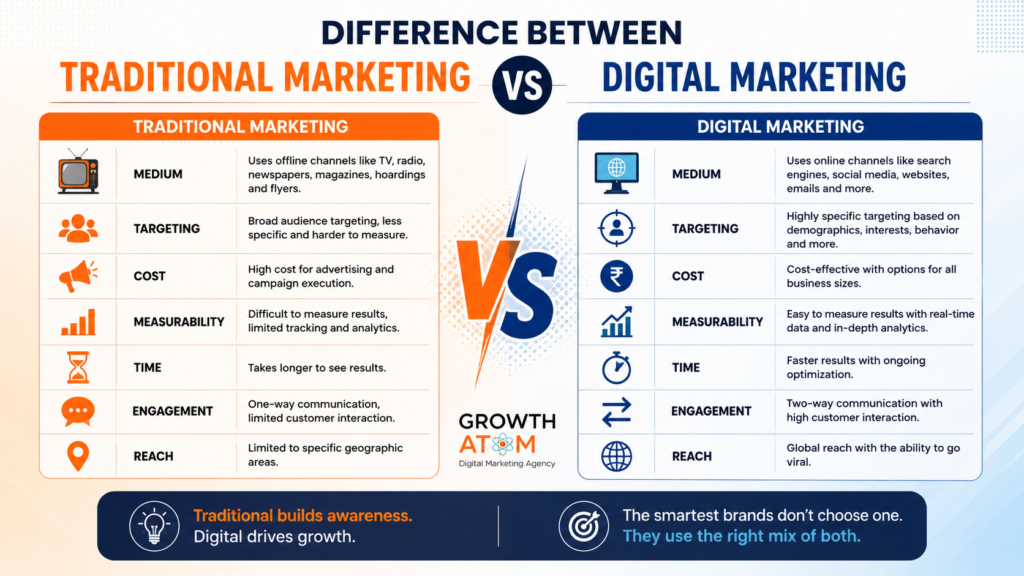
Every business owner faces this question at some point – should I put my money into a newspaper ad or run a Facebook campaign? Should I invest in a billboard, or would Google Ads give me a better return? The debate between digital marketing and traditional marketing has been going on for years, and honestly, it’s not as black and white as most people think.
Whether you’re a startup in Kolkata trying to make your first mark, or an established brand looking to scale, understanding how these two approaches differ can save you a lot of money, time, and frustration. So let’s break it down, no jargon, no fluff, just what actually matters for your business growth.
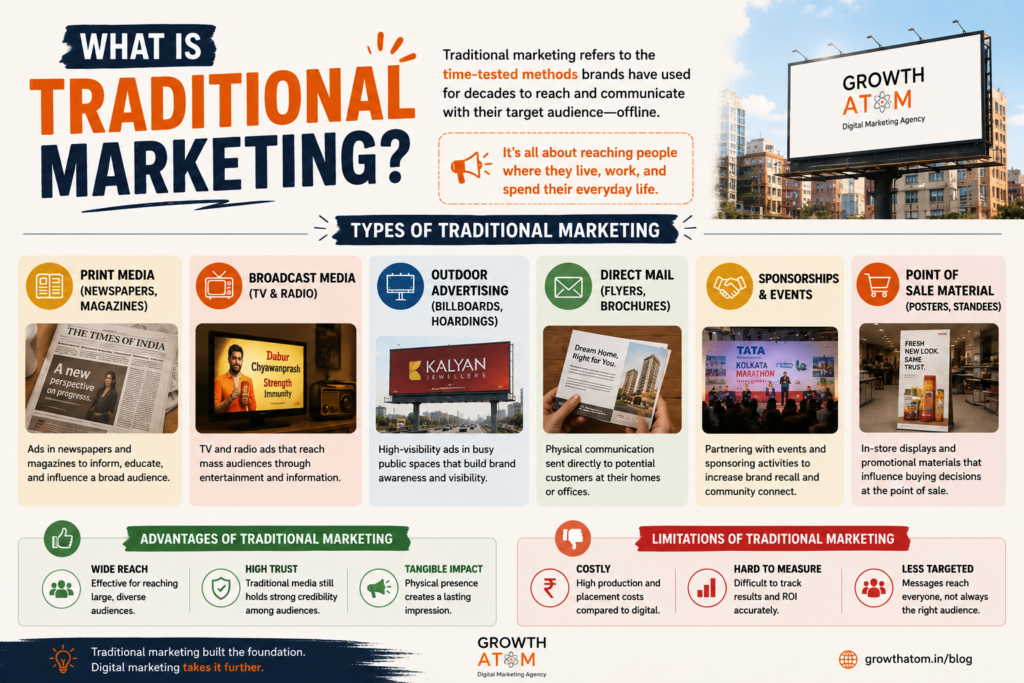
Traditional marketing refers to any form of promotion that uses offline channels to reach customers. Before the internet existed, this was the only game in town — and it worked incredibly well for decades.
Think of the massive Durga Puja newspaper inserts, the catchy jingle on your favourite FM radio station, or the glossy pamphlet shoved under your door. That’s all traditional marketing doing its thing.
It typically follows a linear path of customer engagement — creating Interest, building Awareness, triggering Desire, and driving a Decision. The message is broadcast to a wide audience, and the brand hopes the right people are listening.
Traditional marketing is still relevant today — especially for building local brand credibility and reaching demographics that aren’t heavily online.
Traditional marketing isn’t just print and TV. It covers a broad range of offline tactics:
Each of these channels has its place — and used correctly, they can still deliver strong results for the right audience.
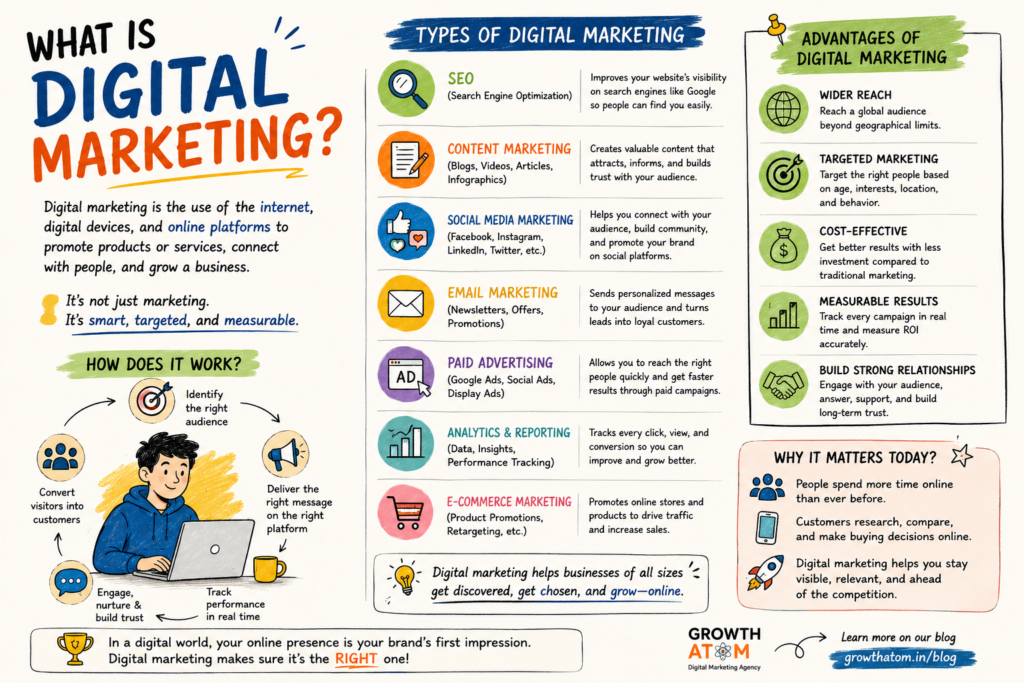
Digital marketing is the practice of promoting your brand, product, or service through online channels and digital platforms. It’s where your audience already spends a significant chunk of their day — scrolling Instagram, watching YouTube, searching on Google, or reading emails.
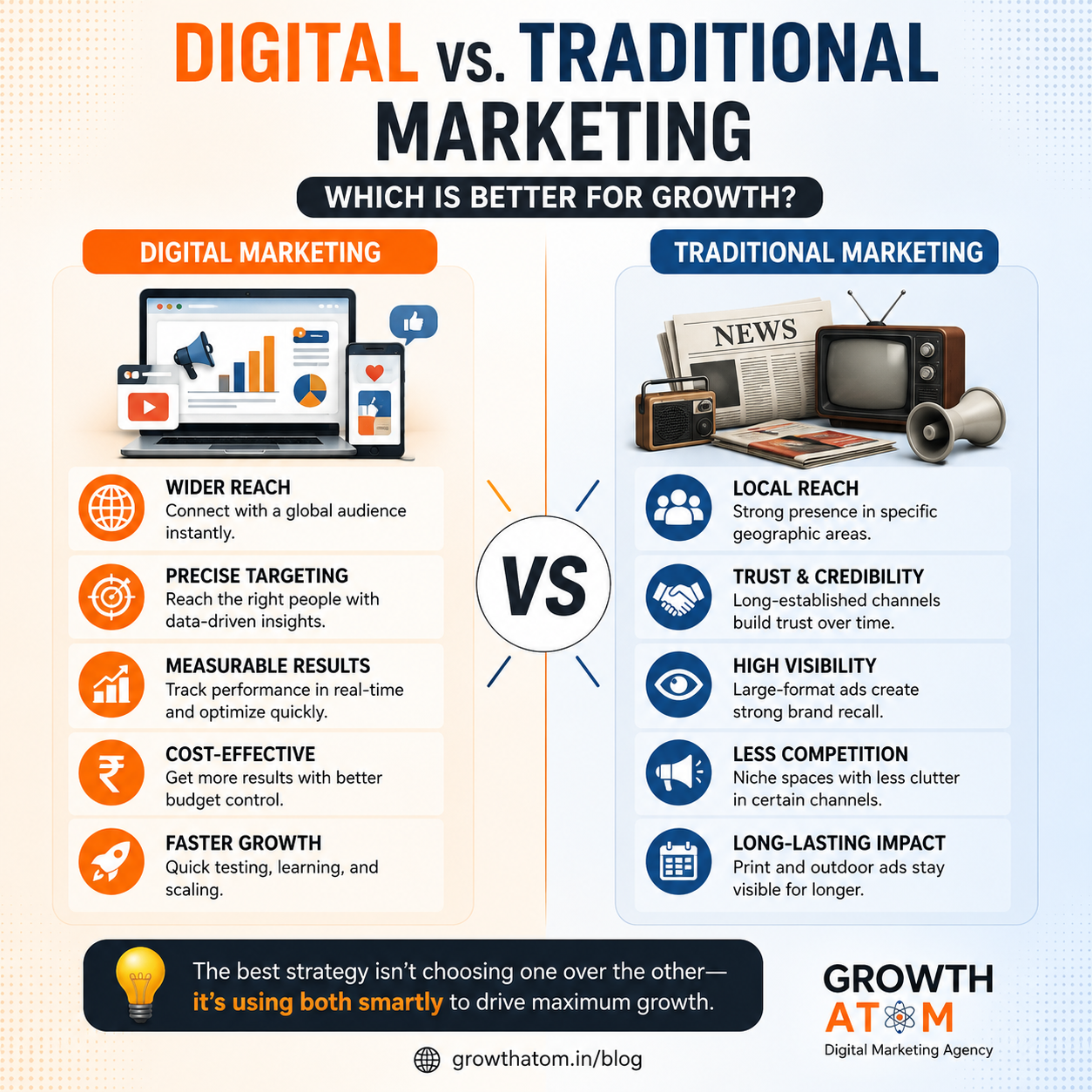
Unlike traditional marketing, digital marketing is highly measurable, interactive, and allows for laser-sharp targeting. You’re not just hoping the right person sees your message — you’re placing it directly in front of them based on their age, location, interests, behaviour, and buying intent.
Digital marketing encompasses everything from Search Engine Optimisation (SEO) and Social Media Marketing (SMM) to Pay-Per-Click (PPC) advertising, Email Marketing, Content Marketing, Performance Marketing, and beyond. At Growth Atom, these aren’t just services — they’re growth engines we tailor to each brand’s unique goals.
| Parameter | Traditional Marketing | Digital Marketing |
| Reach | Local or regional, mass audience | Global, with hyper-local targeting options |
| Cost | High — TV, print, and radio are expensive | Flexible — suits any budget, big or small |
| Targeting | Broad, demographic-based | Precise — based on interests, behaviour, intent |
| Measurability | Difficult to track exact ROI | Fully trackable with analytics tools |
| Engagement | One-way communication | Two-way — likes, shares, comments, DMs |
| Speed | Slow — weeks to plan and execute | Fast — campaigns live within hours |
| Personalisation | Limited | High — tailored to individual users |
| Flexibility | Low — hard to edit once published | High — easy to tweak campaigns in real time |
| Trust Factor | High — print and TV feel credible | Growing — social proof and reviews build trust |
| Best For | Local brand awareness, older demographics | Lead generation, conversions, global growth |
Here’s the honest answer neither is universally better. The right strategy depends entirely on your business goals, target audience, industry, and budget.
If you’re a local service brand a clinic, a boutique, a restaurant traditional marketing helps you build visible, tangible community presence. But if you’re trying to grow your customer base, generate leads online, or scale beyond your city, digital marketing is non-negotiable.
In 2026, the most successful brands aren’t choosing between the two. They’re using both intelligently, intentionally, and in sync.
The marketing landscape has evolved dramatically, but one thing hasn’t changed your audience needs to know you, trust you, and choose you. Traditional and digital marketing are two different roads to the same destination. The brands that understand when and how to use each approach are the ones that grow fastest.
At Growth Atom, we help businesses from startups to established brands build marketing strategies that are rooted in data, driven by creativity, and designed for measurable growth.
Still relying only on traditional marketing while your competitors scale online? The window to catch up is shrinking — and the brands investing in smart digital strategies today are the ones dominating tomorrow. Whether you need SEO that ranks, social media that converts, or a full-stack growth strategy built around your goals — Growth Atom is ready to make it happen. Let’s Talk →