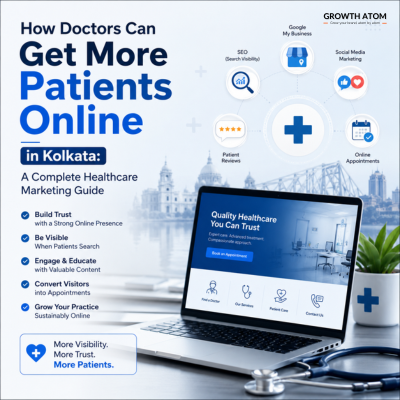
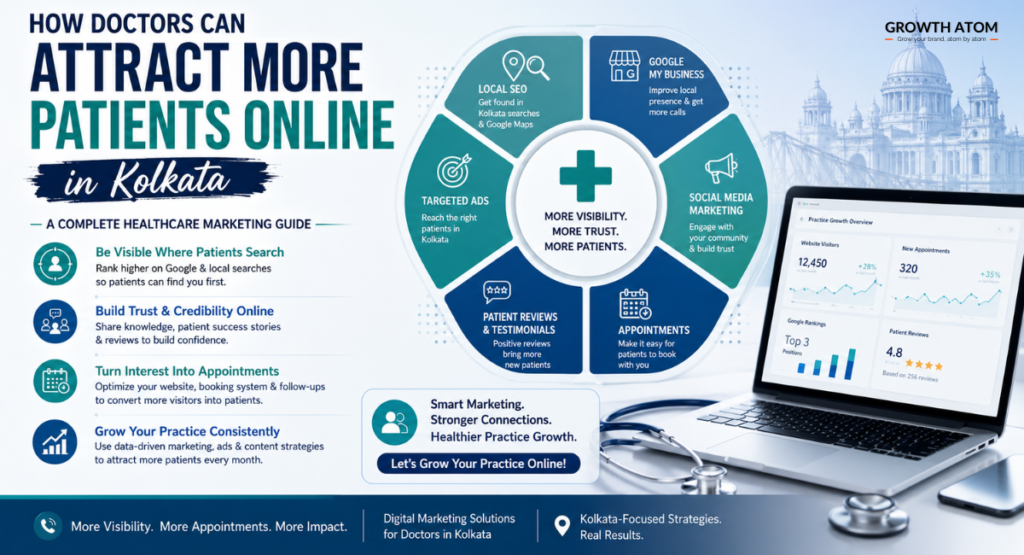
Healthcare in Kolkata is more competitive than it has ever been. New clinics are opening in Salt Lake, Behala, and New Town every quarter, hospital chains are expanding, and diagnostic centers are multiplying along every major road. At the same time, patient behaviour has changed permanently before booking an appointment, most patients now search Google, read reviews, check a doctor’s Google Business Profile, and scroll through Instagram before ever picking up the phone.
Industry data backs this up: over 70% of patients research a doctor online before their first visit, and nearly half say online reviews are as trustworthy as a personal recommendation. If your clinic isn’t visible, credible, and easy to book online, you are losing patients to competitors who are even if your clinical care is superior.
This guide breaks down exactly how doctors, dental clinics, diagnostic centers, and hospitals in Kolkata can build a strong, ethical, and effective healthcare digital marketing strategy that consistently brings in new patients.
Traditional patient acquisition referrals, walk-ins, and word of mouth still matters, but it no longer scales. Medical marketing today is about being present at every digital touchpoint where a patient makes a decision: search engines, maps, social media, and review platforms. Clinics that invest in doctor marketing consistently report shorter patient acquisition cycles, higher-value patients, and better retention, because digital channels let you build trust before the first appointment rather than during it.
Today’s patient journey rarely starts with a phone call. It typically follows this pattern:
A successful patient acquisition strategy maps content and touchpoints to each of these five stages instead of only focusing on the final “booking” step.
Your website is your digital clinic front desk. It needs to:
A cluttered, outdated, or slow website is often the single biggest reason a Google search doesn’t convert into a phone call.
Local SEO for doctors is the highest ROI channel for most practices because it targets patients actively searching nearby. Key steps include:
Strong healthcare SEO compounds over time unlike ads, it keeps generating patients long after the work is done.
Google Business Profile for doctors is often the very first impression a prospective patient forms. To optimize it:
Clinics with complete, active profiles consistently rank higher in Google’s local “map pack,” which is where the majority of local healthcare searches convert.
Educational content builds authority and answers the questions patients are already searching for root canal pain, diabetes symptoms, vaccination schedules, and more. A strong content plan includes:
Consistent content marketing also feeds your SEO and social channels, multiplying the value of each piece you create.
Healthcare social media marketing builds familiarity and trust before a patient ever calls. Effective formats include:
Instagram and Facebook typically work best for clinics; LinkedIn is valuable for hospital administrators and B2B healthcare partnerships.
A single unanswered negative review can cost you dozens of future patients. Online reputation management for healthcare should include:
Reputation isn’t just damage control, it’s a trust building asset when managed consistently.
Most satisfied patients simply never think to leave a review unless asked. Build a system:
A steady stream of fresh, genuine reviews is one of the strongest local ranking and trust signals available.
Video builds trust faster than any other format. Doctors who post short explainer videos, procedure walkthroughs, or patient FAQs see significantly higher engagement and enquiry rates than text only content. Even simple, well lit smartphone videos, a doctor explaining a common condition in under 90 seconds consistently outperform polished but generic clinic promos.
Organic growth takes time; Google Ads deliver immediate visibility for high-intent searches like “emergency dentist Kolkata” or “IVF specialist near me.” Best practices:
A well-run PPC campaign can fill new-doctor or new-branch calendars fast while your SEO builds momentum.
Acquiring a new patient costs far more than retaining one. Email (and WhatsApp) marketing keeps your clinic top of mind through:
Automation reduces no shows and frees front desk staff for patient care. Common use cases include automated appointment confirmations and reminders, post visit review requests, birthday and preventive care nudges, and lead follow-up sequences for enquiries that don’t convert immediately. For growing clinics, automation is what makes consistent marketing sustainable without hiring a large in-house team.
AI is reshaping how patients discover care from AI-powered chat answers to smarter ad targeting. Practical applications for clinics include AI chatbots that handle appointment queries after hours, AI-assisted content drafting (always reviewed by a qualified doctor before publishing), and predictive analytics to identify which patients are likely to need follow up care. Clinics that adopt AI thoughtfully without compromising accuracy or compliance gain a meaningful edge.
Healthcare marketing carries responsibilities beyond ordinary businesses. Always:
Ethical marketing protects your reputation and your license cutting corners here is never worth the short-term gain.
Track what actually predicts growth, not just vanity numbers:
Patients in Kolkata are searching for care online right now the question is whether they’re finding you or your competitor. A strong healthcare digital marketing strategy that combines local SEO, an optimized Google Business Profile, ethical content, consistent reviews, and smart advertising isn’t optional anymore; it’s the modern front desk of your practice.
Growth Atom has helped healthcare brands in Kolkata, including ENT and dental practices, build exactly this kind of digital presence – one that turns online visibility into a full appointment calendar, without compromising on medical advertising compliance.
Ready to attract more patients online?
Talk to Growth Atom today for a free healthcare marketing audit of your clinic or hospital’s online presence.
Call us at +91 7980871978 or email growthatom@gmail.com to get started.
1. How much should a clinic in Kolkata budget for digital marketing? It varies by speciality and competition, but most clinics see meaningful results starting with a monthly budget that covers local SEO, Google Business Profile management, and a modest ad spend. A digital marketing agency can recommend a realistic figure after an audit.
2. How long does healthcare SEO take to show results? Local SEO typically shows initial movement in 2–3 months, with strong, compounding results by month 6 onward. PPC can deliver leads within days.
3. Is social media really necessary for a medical practice? Yes, it builds familiarity and trust before a patient calls, and it strengthens your credibility when prospective patients check your profile after finding you on Google.
4. Can doctors run Google Ads without violating medical advertising rules? Yes, if ads focus on information (services, location, credentials) rather than promotional claims like “best” or “guaranteed cure,” which NMC guidelines discourage.
5. What’s the fastest way to improve Google Business Profile rankings? Complete every field, add fresh photos regularly, post updates weekly, and actively generate new reviews, these four actions move the needle fastest.
6. How do I handle a negative review professionally? Respond promptly and calmly, avoid disclosing any patient details, acknowledge the concern, and offer to resolve it offline through a direct contact channel.
7. Should hospitals and large clinics approach marketing differently than solo practitioners? Yes, hospitals typically need multi-department SEO, PPC across specialities, and a stronger content and PR strategy, while solo practitioners often see faster ROI from hyper-local SEO and Google Business Profile optimization.
8. Do I need a specialized healthcare marketing agency, or can any digital agency do this? A specialized agency understands medical advertising compliance, patient trust dynamics, and healthcare-specific SEO all of which reduce risk and improve results compared to a generic marketing approach.