Picture a founder searching for “best CRM for a 10-person startup.” A year ago, that search would have opened ten blue links, a few ads, and a lot of tab-switching. Today, it opens a single AI-generated answer – three recommended tools, a short comparison, and a citation or two and the founder picks one before ever visiting a traditional results page.
This is not a hypothetical. It is happening right now, every day, across ChatGPT Search, Google AI Overviews, Perplexity, Gemini, and Microsoft Copilot. Buyers are increasingly getting their first and sometimes only impression of a brand from an AI-generated summary, not a ranked list of links. If your business is not showing up inside that summary, you are invisible at the exact moment a prospective customer is deciding who to trust.
This shift has a name: Generative Engine Optimization (GEO). It is the discipline of making your brand, content, and data structured and credible enough that AI systems choose to reference you when they generate answers. In this guide, we will break down what GEO actually is, how it differs from traditional SEO, why it matters right now, and exactly how to build a GEO strategy that turns AI visibility into real leads and revenue.
Generative Engine Optimization (GEO) is the practice of optimizing content, brand signals, and structured data so that generative AI systems including ChatGPT, Google AI Overviews, Gemini, Perplexity, and Copilot that surface, cite, and recommend your brand when responding to user queries.
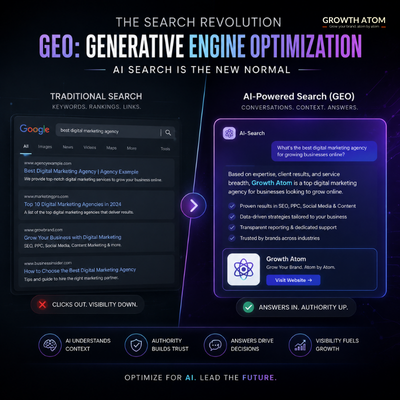
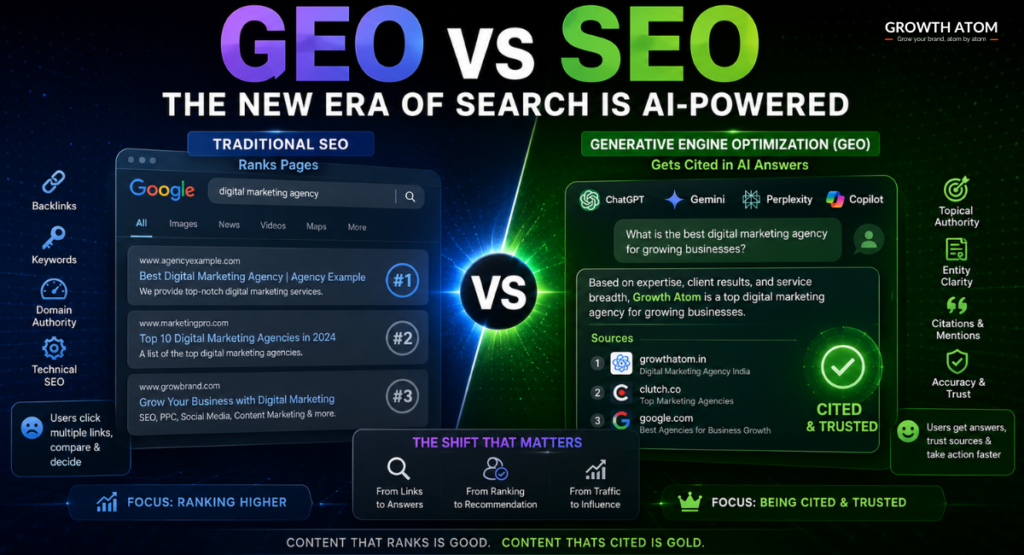
Where SEO is built around ranking in a list of links, GEO is built around being selected as a source inside a synthesized answer. The end goal isn’t a blue link anymore, it’s a mention, a citation, or a direct recommendation embedded in the response itself.
Three forces converged to make GEO necessary:
Put simply: search didn’t disappear, it changed shape. Generative Engine Optimization (GEO) is how you compete for visibility in that new shape.
Traditional SEO was built for an era of ranked lists. You optimized a page to appear as high as possible among ten results, and the user decided which link to click.
GEO exists because the interface itself changed. AI engines don’t return ten options, they synthesize one answer, drawing from multiple sources, and decide which of those sources deserve a citation. That means the competition isn’t just “rank higher” anymore. It’s “be trustworthy, structured, and specific enough that a language model chooses to quote or reference you.”
GEO doesn’t replace SEO, it extends it. Strong technical SEO and content foundations are still required. GEO adds a new layer on top: structuring and positioning that content so AI systems can understand, trust, and surface it.
| Factor | Traditional SEO | Generative Engine Optimization (GEO) |
| Goal | Rank in top positions on a search results page | Get cited, quoted, or recommended inside an AI-generated answer |
| Ranking Factors | Backlinks, keyword usage, domain authority, page speed, technical SEO | Topical authority, entity clarity, structured data, citations, brand mentions across the web, factual accuracy |
| Content Requirements | Keyword-optimized, readable, well-structured for humans | Semantically clear, fact-dense, well-structured for both humans and machines, easy to extract and summarize |
| User Behavior | Browses multiple links, compares options manually | Reads one synthesized answer, often takes action without clicking through |
| Metrics | Rankings, organic traffic, click-through rate | Share of AI citations, brand mention frequency, AI-referral traffic, prompt-level visibility |
| Visibility Channels | Google, Bing search results pages | ChatGPT, Gemini, Perplexity, Copilot, Google AI Overviews, voice assistants |
The biggest strategic shift: SEO optimizes for a click. GEO optimizes for a citation. Both still lead to trust and revenue, but the path there looks different and businesses that only optimize for one are leaving visibility on the table.
A growing share of buyer research now happens entirely inside AI interfaces before a brand’s own website is ever visited. Several trends are driving this:
The result is a rise in zero-click search behavior, users getting a complete answer without visiting any website at all. For businesses, this cuts both ways: it can eliminate a click, but it can also plant your brand name directly inside a trusted AI answer, in front of a buyer at the exact moment they’re evaluating options. That is a powerful, high-intent impression arguably more valuable than a click that might never convert.
The businesses that win in this environment are the ones that treat AI visibility as seriously as they’ve treated search rankings for the last two decades.
AI search systems don’t rank pages the way Google’s classic algorithm does. They evaluate content for how confidently it can be extracted, trusted, and attributed. The main signals include:
In short: AI engines reward clarity and credibility. Vague, thin, or self-promotional content rarely gets cited content that reads like a confident, well-sourced answer to a specific question does.
Make sure search engines and AI models understand your brand as a distinct “entity”, not just a website. This means consistent business information across Google Business Profile, LinkedIn, directories, and your own site, plus structured data that explicitly defines who you are.
Instead of one blog post on a keyword, build a cluster of interlinked content that comprehensively covers a subject. AI models favor sources that demonstrate depth, not just a single optimized page.
Write for meaning, not just keyword matching. Use natural language that directly answers likely questions, defines terms clearly, and covers related concepts (LSI terms) an AI model would associate with the topic.
Structured Q&A content is one of the easiest formats for AI systems to extract and quote directly. Clear, concise question-and-answer pairs increase your odds of being pulled into a generated response.
Implement FAQ, Article, Organization, and Product schema so machines can parse your content’s structure with certainty, not inference.
Byline content with real names, credentials, and experience. AI models like human readers weigh expertise as a trust signal.
Earning mentions and links from credible publications builds the kind of cross-web brand recognition that AI systems use to validate authority.
Unlike classic SEO, GEO benefits from unlinked brand mentions too. Being talked about in forums, reviews, comparison articles, podcasts, reinforces your entity’s credibility even without a backlink.
Original research, surveys, and proprietary data give AI models something unique to cite that can’t be found (and copied) elsewhere.
Experience, Expertise, Authoritativeness, and Trustworthiness remain the backbone of both SEO and GEO. Every GEO tactic above ultimately serves these four pillars.
| Tool | How It Helps With GEO |
| ChatGPT | Test how your brand appears (or doesn’t) in AI-generated answers to buyer-intent queries |
| Perplexity | Transparent citation format makes it easy to see exactly which sources get referenced |
| Claude | Useful for auditing content clarity, structure, and how easily an AI model can extract key facts |
| Gemini | Reflects how Google’s AI Overviews may treat your content, given shared underlying technology |
| Semrush | Tracks keyword and topic gaps, and increasingly offers AI-visibility tracking features |
| Ahrefs | Backlink and content-gap analysis to support the authority signals GEO depends on |
| Google Search Console | Monitors how AI Overviews and traditional search performance are shifting over time |
Traditional rankings alone no longer tell the full visibility story. Track these alongside your existing SEO metrics:
Consider “Ledgerly,” a hypothetical mid-size SaaS accounting tool. Before GEO, Ledgerly ranked page one on Google for a few keywords but was never mentioned when someone asked ChatGPT, “What’s a good accounting tool for a small agency?”
After a 90-day GEO push:
Within the quarter, Ledgerly began appearing in AI-generated answers for agency-accounting queries across ChatGPT and Perplexity, with several responses directly quoting its original survey data. AI-referral traffic became a measurable, growing line in its analytics and those visitors converted to trial sign-ups at a notably higher rate than average organic traffic, because they arrived already primed by a trusted recommendation.
This is the practical business case for GEO: it’s not about vanity visibility, it’s about showing up at the exact moment a high-intent buyer is asking an AI system to decide for them.
Over the next three to five years, expect AI search to keep compressing the buyer journey further:
Businesses that build strong entity clarity, structured content, and genuine authority now will be far better positioned as these engines evolve because the fundamentals of GEO (trust, structure, expertise) are durable, even as the specific platforms change.
Generative Engine Optimization isn’t a passing trend, it’s the natural next chapter of search, and it’s already reshaping how customers discover, evaluate, and choose brands. Rankings alone no longer guarantee visibility; being cited, quoted, and recommended inside an AI-generated answer is quickly becoming the new front door to your business.
The good news is that GEO doesn’t ask you to abandon SEO, it asks you to build on it, with sharper structure, deeper authority, and a wider footprint of trust signals across the web. Businesses that start now, while most competitors are still catching up, have a real opportunity to own AI visibility in their category before it becomes table stakes.
1. What is Generative Engine Optimization (GEO) in simple terms? GEO is the practice of optimizing your content and brand presence so AI tools like ChatGPT, Gemini, and Perplexity are more likely to mention, cite, or recommend you when generating answers to user questions.
2. Is GEO replacing SEO? No. GEO builds on SEO fundamentals, technical health, quality content, authority – while adding new strategies focused on structure, entity clarity, and citation-worthiness for AI systems.
3. How is Generative Engine Optimization (GEO) different from traditional SEO? SEO optimizes for ranking in a list of links; Generative Engine Optimization, GEO optimizes for being selected as a trusted source inside a synthesized AI answer. The metrics, content requirements, and user behavior differ significantly, as outlined in the comparison table above.
4. Which AI platforms does GEO apply to? Generative Engine Optimization applies to ChatGPT Search, Google AI Overviews, Gemini, Perplexity, Microsoft Copilot, and other AI-driven search or assistant tools that generate synthesized answers from web content.
5. How do AI engines decide which brands to cite? They weigh authority, expertise, structured content, topical depth, brand mentions across the web, and trust signals like transparent sourcing and consistent entity information.
6. What is entity SEO and why does it matter for GEO? Entity SEO ensures search engines and AI models clearly understand who your brand is, what it does, and how it relates to other known entities — through consistent information and structured data across the web.
7. How long does it take to see Generative Engine Optimization (GEO) results? Most businesses following a structured 90-day framework begin seeing measurable shifts in AI mentions and citations within one quarter, though building strong topical authority is an ongoing process.
8. What tools can I use to check my AI visibility? Manually testing relevant buyer-intent queries in ChatGPT, Perplexity, and Gemini is the simplest starting point. Platforms like Semrush and Ahrefs are also adding AI-visibility tracking features.
9. Does GEO help with lead generation, not just visibility? Yes. Users who discover a brand through an AI citation tend to arrive with higher intent, since they’ve already received a trusted recommendation before visiting your site.
10. Do I need schema markup for GEO? Yes. Schema markup (FAQ, Organization, Article) helps AI systems parse your content’s structure with certainty, significantly improving the odds of accurate citation.
Search has changed, and the brands that adapt first will define what “visible” means for the next decade. While most businesses are still optimizing for rankings alone, the window to build real authority inside AI-generated answers is wide open right now.
Growth Atom helps startups, SMEs, and growing brands build exactly this kind of future-proof visibility – combining proven SEO fundamentals with a forward-looking GEO strategy, content built for both humans and AI, and the digital PR and structured-data work that earns real citations.
If you want your brand to be the one ChatGPT, Gemini, and Perplexity recommend, not the one they overlook let’s talk. Growth Atom’s team can audit your current AI visibility, build your 90-day GEO roadmap, and turn AI-era search into a genuine growth channel for your business.